Saturday, April 28, 2012

The Art of Gaming in Japan: A Project Update


I have been sifting through some articles online and considering my project more heavily. If you take a look at the post just below this one, you may notice I was originally going to look at the dichotomy of the visuals in gaming from the east and west. In most cases, the two are opposed completely, both in their artistic representations, but also their core game design. This is interesting, but fails to deliver any kind of concise conclusion. "Look, they aren't like one another," would be the ultimate summary of the project, and that's not compelling.

For that reason, I'll be focusing exclusively on games from Japanese developers. Often times these games reflect the look of the woodblock prints we looked at, Nara's artwork, and Murakami's superflat aesthetic. Something interesting about this research is that the visual design of these games mirrors things we've studied. More interesting is how the actual core design is reflective of some of the concepts we've talked about, primarily mujo.

This tighter scope of observation will (I hope) bring about a more focused and relevant project. Below are the sources I'll use; mostly to contextualize what I'll be talking about, the majority of the project will be dedicated to comparing the imagistic styles of the games and the sub-cultures and pre-existing Japanese art they resemble. Pardon the lateness! If anyone would be willing to drop any helpful comments I would very much appreciate it.

P.S. The images included are meant only to give examples of the kinds of games I'll be looking at. Since this is art in motion, I'll likely move through many different images and utilize videos for my PowerPoint. Thank you!

Sources:

"Games, The Lively New Art" by Henry Jenkins: HERE
"Art Form for the Digital Age" by Henry Jenkins: HERE
"Some Notes on Aesthetics in Japanese Video Games (pg. 211)" by William Hurber: HERE
"Haunting Backgrounds" by Martin Picard: HERE
"The Cultural Economy of Ludic Superflatness" by Dean Chan: HERE


Thursday, April 5, 2012

Art Direction in Video Games: East vs. West


Game journalists are keen to always make the distinction between western and eastern games. This is because, in most cases, the mechanical and visual function of the two categories are opposed. Rarely, if ever, do the two influence each other. Beside the fact that the base gameplay is often different from games produced in the states, the artistic vision of Japan's games are vibrant and distinct, often taking cues from the japanese artwork and manga that came before.


My project will draw comparisons between these two parties of game development, and speculate on how the art direction in eastern gaming came to fruition. Furthermore, the ideologies of designers are often quite different one's in the west, bringing about new visions for their products beyond their look. It will be important that some element of the project focuses on the thoughts of the people who make these games, in addition to their final products.

Possible Sources:
"That Game Company Interview" Here
"Art in Service of Gameplay" Here
"Art Direction in Games is Rubbish" Here
"Interview with Nick Clark" Here
"NYCC Article" Here

Takashi Murakami + Nara Yoshitomo

(Takashi Murakami's "Cosmos")

During the 1980's, Japan's consumer culture started coming to a head. Most citizens were involved in the commercial business, allowing for some to lead a "pure consumer" lifestyle. With this cultural shift, the line between fine art and consumerism was blurred, giving way to a new face of art. Murakami is one of the flagship artists of this new movement, often combining pop-culture and consumer goods with the craftsmanship of any good art work. Many of these images have "kawaii" qualities. The innocent cuteness of these works is indicative of a time when some women could only survive in closed, anti-social environments. Murakami's creativity is fully aware of what it is, designed to expose the narcissistic nature of this new culture.

This new artistic synthesis can be spotted just in the color scheme alone. There's something almost garish about the bright, multicolored flowers (a common image of Murakami). The stylized smiles on the flowers presents this more as patron piece rather than an art piece. This kind of design would seem more suited to a children's toy or cartoon, but the tasteful (and highly deliberate) spacing of the vines helps satisfy the artistic precision. The distribution of vines allows the eyes to roll playfully down its length. "Cosmos" was painted on three joined canvases. It's difficult to discard the comparison to traditional Japanese interior - truly, it looks like a sliding door. This choice, be it deliberate or not, its powerful since it reflects the closed, introverted nature of a consumerist society.


(Nara Yoshitomo's "Home")

Nara's work often expresses a nostalgic yearning for the past. His images of fresh faced girls are conveyed through simplistic color schemes and minimalist design. In terms of his artistic output, he seems obsessed with the appearance of youth. Children are an interesting thing to focus on. They've not fully assumed the role of their body or consciousness, thus existing in a kind of limbo space where they're unbiased and not fully "formed." There's always a struggle between the real and unreal in Nara's work, a full acknowledgement of not one, but two realms of being.

The backgrounds are rarely given much attention. This presents the viewer with a clean viewing frame, sure, but this helps satisfy these concepts even more. Oceans of color, like the one above, express an exposure to the infinite, a search for equilibrium among any number of possibilities or directions. Interesting, then, that the image of this girl depicts her looking for something, in this case, a house. She's largely disassociated with her surroundings - she's not even aware of what direction she's headed in fact. The lack of realistic scale and proportion clarifies one thing: The little girl is only a piece of her surroundings by circumstance and is mostly disconnected. The scheme of color doesn't convey emotions of joy or wonder, either. In fact, there's something quite solemn and lonely about the piece.

Monday, February 20, 2012

Chizuko Yoshida's "Into the White Strata"

(1970)

Chizuko Yoshida is a woman known for her modernist (and largely abstract) art. Most of these pieces tracked the changing face of art through World War II. Something interesting is that Yoshida's husband, mother and daughter all gained popularity with their production of abstract paintings/woodblock prints. She was born in 1924, and today many of her works reside in the Yokohama Museum of Art and British Museum.

Unsurprisingly, it is not immediately apparent what this image means. A quick glance suggests a high degree of symmetrical awareness, but it's lack of symmetry is ultimately what makes it to intriguing. The two shapes that peel off the side of the boarder don't take up equal space on the sides. Furthermore, the one of the left rises just a bit higher that the one parallel to it. The two dips (before it rises to the candle-like flame) are also slightly disproportionate although though they appear to be even. The spacing of the roses is obviously off, with the bottom-most rose hanging much lower then the two above it.

Looking in the cream colored "sky" above the blue shape one will notice the color bends and winds in order to give the effect of light radiating from the candle. This kind of close detailing is not typical of Yoshida's other abstract work, most of which resembles the "construction paper" look of Strata's bottom half. The disregard of symmetry met with stylistic clashing of the two parts makes this a visually complex and comprehensive image.

A semiotic reading of this image is onerous task just due to how abstract it is. I enjoyed considering Yoshida's interesting family lineage when analyzing this image. A bloodline of three abstract women artists is not only rare, but basically unheard of in any culture. The two shapes on either side of the image, although implied, seem to me like silhouettes of people. Ayomi Yoshida, Chizuko's daughter, and Fujio, her mother could possibly be the two images on the side. They all share the same style of art, sure, but the three women's work all seem to borrow inspiration from one other.

Relating this back to the image, the three blue humps are all connected, sharing life with one another, while still maintaining unique traits (hense the lack of symmetry). Roses, the color blue, and flame all symbolize passion and zeal. All three artists have work in museums and have enjoyed private shows - clearly the sentiment of compassion shown here is mirrored in the beautiful pieces they have produced in the past.

It's a tough one. I'd like to hear other people's thoughts on the piece!

Friday, February 17, 2012

Utamaro's "Bodhidharma Crossing the Yangzi on a Reed"

(1753? - 1806)

There are many reasons to be impressed with Utamaro's delicately placed ink. Contextually, the piece is intriguing due to the deviation from his typical depictions of beautiful women. Additionally, this is one of very few (according to my searches) ink drawings he has ever worked on. While his images of beautiful geisha are brought to life by vibrent blues and rich cream colors, this is simply black and white (minus the very, very minimal staining around the top of the piece). The figure shown here was revered to be the founder of Zen Buddhism in East Asia, named Bodhidharma as the Chinese knew him.

It's a meticulously assembled piece that maintains visual consistency throughout. Bodhidharma's cloak flows seamlessly into the pattern of the water. Despite a lack of vibrancy, there is a powerful use of shading, thick black lines, and untouched canvas - the whole thing looks indefinitely Japanese. Despite it being a static image, it gives the effect of motion with its curvature; there isn't a straight line in the entire piece.

This visual momentum is complimentary to the mythology of Bodhidharma (or Daruma as Japan knew him). This was produced during the Kamakura period, where the concept was Zen was fresh to the minds of the Japanese. Daruma's depiction here is in favor of the mythology surrounding him, dead giveaways including his shriveled feet and animalistic, hairy face. Oh, and his ability travel water on a reed. In this vein of Daruma's depiction, his limbs are always wilted or wrinkled (in this particular case we only have his feet). It is as if his ability to operate in a physical world is leaving him and all the focus and energy is being forced through his head, hence the bulging eyes and piercing stare.

His stern expression is typical of Darumian artwork. More interesting is where his eyes are going. The horsehair wand in his hand is a symbol of high rank in buddhist society, but why is he focused so intently on it? It is as if he is attempting to separate the concept of the thing from the thing itself, a theological staple of zen. Daruma's trip across the Yangzi after falling out of favor with the Chinese emperor. After his flight, he meditates for nine years within a cave. So, this image in in between this transformation, his crossing of a river helps supplement.

This piece could be described as being very "tightly" designed. It's themes, accompanied with historical context are as clear as the highly readable visual technique of the ink. Everything is in motion, the image itself, the literal situation and the mind of Daruma himself.

Tuesday, February 14, 2012

Meiji Portrait

Japan was not always one of the world's superpowers. In fact, during the reign of Emperor Meiji, who we're looking at here, the country experienced a whole renaissance of technology and social restructuring. This cultural evolution was called the Meiji Restoration, quite fittingly. Japan knew they were falling behind the rest of the world when Commodore Perry commentated on the state of the country, asking their ports to be filled with the extravagant warships of the west. Additionally, the emperor was not trying to pull land ownership from the Daimyo to himself - a bulky task considering the feudal system in Japan was completely locked-in. Good to note is that during his lifetime, most of these things were accomplished.

The emperor's gaze is perfectly intense here. Pictures of geisha or more casual shots will often have the subject looking away from the lens. Here, the gaze is calculating and full of danger. Truth be told, he doesn't look happy, he looks tough. That being said, his posture in the chair suggests a relaxed disposition, he is both collected, stress free and bold. The picture is framed, obviously, the purposefully placed hat and side-table help to add to the visual density of the picture. In fact, the pattern of the floor compliments his garments.

What I find most striking is something unintentional in the picture's arrangement. Everything is patterned, the even the tablecloth. The only things that really have solid/smooth colors are the emperor's pants, his face, and the cracking wall behind it. It is as if, wether he will admit it or not, there is a fissure in Japanese society, creeping behind him at all times. This assessment brings about many different connotations. For instance, hard expression is demurred when one's eyes follow the crack just behind it. Perhaps this pose is a front to the reality of cultural catch-up.


Tuesday, February 7, 2012

Persona Though Lantern Slides

(#63)
So, who's that, you say? I wish I could tell ya', partner. Truth is I don't even know. All I know is that I'm a pretty simple fella', run shipments to the east every so often. We keep lotsa' boxes down in the hull but I couldn't tell you what's in 'em. I'm a loyal worker, see? I just get the job done and ask the questions later. That was until I got distracted by this pretty little flower. I don't know 'er, but I know they don't make women like this stateside. First set eyes on her 'bout five months ago. I was carryin' this box of something to one of the fisheries when I spotted her. She's the most beautiful thing I've ever seen in my whole life. Beautiful enough that I dropped whatever was in the box. I broke it. Captain said I was discharged and officially outta' work. So, now I'm going back to the land of the risin' sun. I gotta' find this lass and make her mine. I hope I find 'er. Got no job and all my money was dropped on gettin' here. God help me.

(#49)

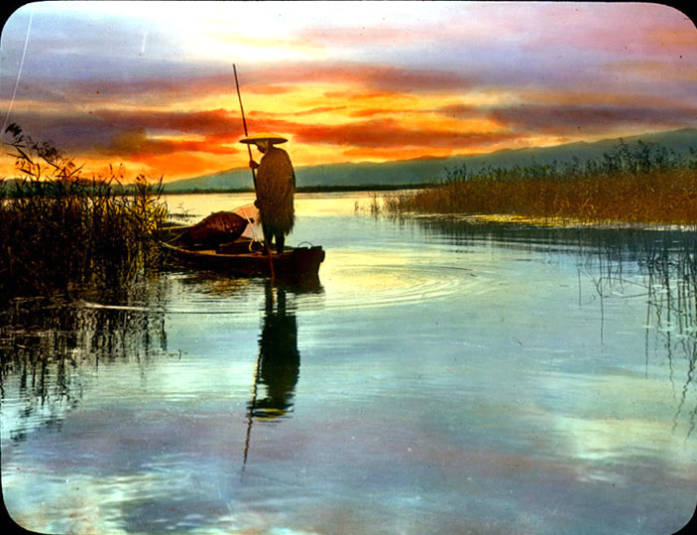
It was somethin' outta' Huckleberry Finn or at least somethin' similar. This was snapped just moments after he dropped us off in this freakin' place. Except he didn't just take off immediately. I mean, how could he really? What, with that sorry excuse for an oar in his hand. Nah, he was just fishin'. Some modest fishin' if you ask me, though. Get this guy a proper paddle and a net so he can put something other than a bowl a' rice on the table. Don't even get me started on that dome cover. What is that? Looks to me like a salad bowl breedin' with a sun hat. Foolish, foolish people. Sunset sure is a beaut. In fact, this whole place is a pretty thing. Not so steamy and the airs' got less bugs flappin' around.

(#77)

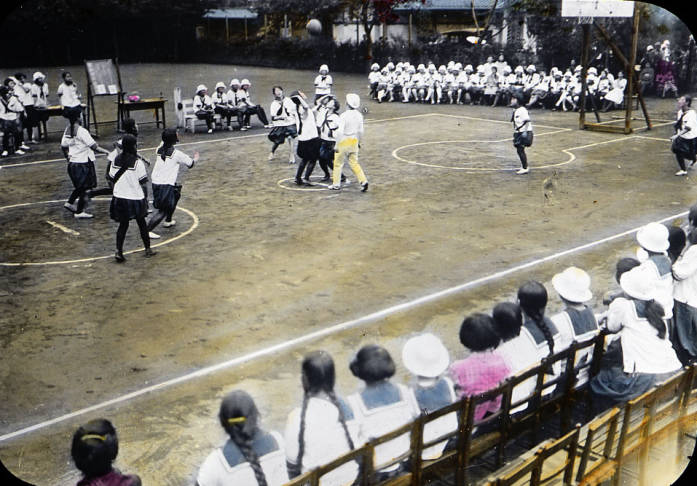
Climbed up here to get my barrins'. Been awhile since we stopped in this port. Fella' who I showed the picture to said she played some sport but he didn't know where the court was. My translator, and my picture guy I suppose, did all the talkin'. Don't get the wrong idea, I don't speak a lick of whatever you'd call those silly noises. The land here is a sight if you couldn't already tell. Walkin' though the town felt cramped as the circles a hell, lemmie tell ya. Out west we like to place our stuff nice an' even. These folks treat their estates like they were bricks, one goin' on top of the other. Nature out here feels good, airs' clean. I was able to spot what looked like a basketball court in the westward corner of the place. Guess I'll start walkin'. Hope this is the right place.
(#64)

Oh, doggy. My girls' and athlete, too! Me and my buddy here just watched 'em all play for a little while. Thought my heart was gonna' blow up right outta' my chest. camera guy here, I saw his eyes shiftin' all around, but I only watched her. I knew she was the one. This aint' the normal sport watchin' crowd I'm used to back home. I can't quite think of the word I'm lookin' to describe it... encourageized? That aint' a word. Hmm, maybe just everyone takes less of a issue with cheerin' on the other team. Seems to me like they just havin' fun out there. Enough 'bout the team, tough. I'm about to meet my lovely bride - I just know it! I saw her dodge out to one of the buildings and she nere' came out. What's she doin' in there? Maybe her house? Now's my chance I suppose...

(#66)

Now, I'm pretty sure if you were around you'd be able to hear my very own heart snap. I slid aside that door, proud as a lion and found these two just layin' there. She ain't gonna' love me now. Hell, she doesn't even like my flavor a human! That's a doggone female layin' next to my woman! Who's a female! I wasn't sure if I felt mad, confused, or just heartbroken. They were just sleepin' there... so I told my guy to snap a snappy for later. That way I could at least see her face one last time. I wanted to wake 'er up just so she'd notice me but I let her sleep. I was a little freaked out, too. I slid the door closed and wandered around town, not sure where to go next...

-------------------------------------------------------------------------

I wanted to create a southern inspired, more or less "simple" minded man who was driven by lust. I figured that this would allow him to have a reason to be curious about the environment while still maintaining a highly critical color of speech. He's impulsive and not very perceptive. In fact, if I met this slate in real life I'd probably think he was pretty boring. I don't think he likes Japan, just it's women. So, basically he's just interested in what he can gain from the east, ultimately. This was pretty fun, though!